Shopware
Introduction
Our Shopware plug-in comes with regular updates and full integration support, offering a versatile out-of-the-box solution to accept online payments easily:
- Hosted Checkout Page: Redirect your customers to the GoPay payment page for any of our available payment methods.
- Hosted Tokenization Page: Include an iFrame in your checkout page for card payments.
- Redirect Payments: Allow your customers to choose their preferred payment method directly on your checkout page by introducing single payment buttons.
Find the complete list of payment methods the plugin supports in our payment methods overview.
Keep an eye on our Release Notes to stay informed about updates and new features (i.e. payment methods, features, integration methods) we have added to this plugin!
Check out our documentation to learn how to link your store with our platform to profit from all these features!
Shopware Marketplace
Account Creation
To process transactions with this plugin, you need an account on our platform.
This plugin works with both our test and live environment. A test account is a great way to get familiar with both the plugin and our platform. Once you want to go live, create a production account or contact us!
Installation
Installation
The first step to use the plugin is the installation process. Before you proceed, make sure your infrastructure meets these system requirements:
| Item | Description |
|---|---|
| Plugin package | |
| GoPay credentials |
|
| Shopware |
This plugin supports Shopware version v6.5.x.x and above |
| PCI compliancy |
SAQ A |
Once done, install the plugin in one of two ways:
By manually uploading the manifest:
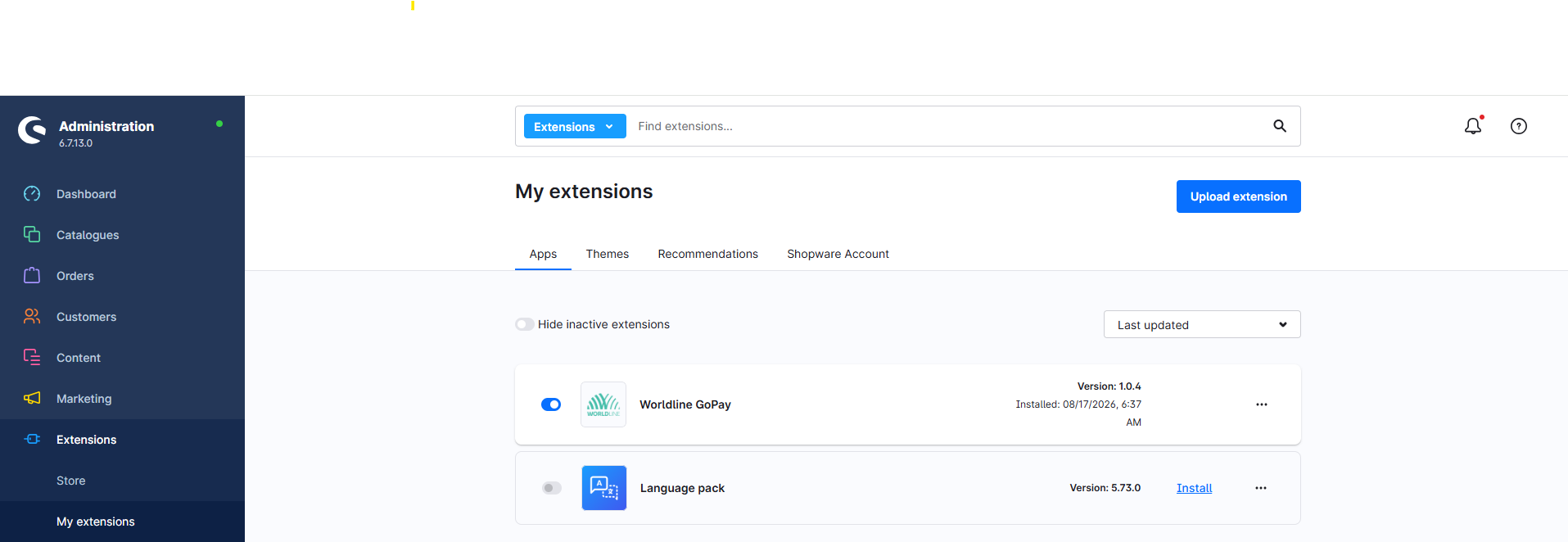
- Login to the Shopware Back Office. Go to Extensions > My extensions > Upload extension.
- Click on the "Upload extension" button. Click on "Confirm" on the pop-up menu and upload the package.
- Click the "Install" button, and wait for the page to reload.
- Once installed, enter "Worldline GoPay" in the “Find extension… “ search bar. Activate the extension using the slider.
Using the Shopware Marketplace:
- Login to the Shopware Back Office. Go to Extensions > Store.
- Search for "Worldline GoPay".
- Click the "Install" button.
Configuration
After the installation, you need to configure the plugin to link your store to our platform.
Configure General Settings
1. Login to the Shopware Back Office. Go to Extensions > Worldline GoPay.
2. In "Settings", configure the following options:
| Property |
Description/Actions |
|---|---|
| Mode |
Select between 'Test' or 'Production' to link your shop to the respective environment. Depending on your selection, the shop module will send the transaction requests to the test or production environment. Make sure to:
|
| PSPID |
Enter your test/live PSPID from our platform that you want to use for transaction processing. |
| API Key |
Enter the test/live API Key of your test or live PSPID. Read our dedicated guide to learn how to generate one. |
| API Secret |
Enter the test/live API Secret of your test or live PSPID. Read our dedicated guide to learn how to generate one. |
| Webhook key |
Enter the webhooks Key of your test/live PSPID from the Merchant Portal as described in our dedicated guide. |
| Webhooks secret |
Enter the webhooks Secret of your test/live PSPID from the Merchant Portal as described in our dedicated guide. |
| Webhooks URL |
Copy this URL into the Endpoint URLs fields in the GoPay Merchant Portal as described in our dedicated guide. in our dedicated guide. |
3. Click on the "Save changes" button to save your credentials and to verify the configuration by establishing a test connection between the plugin and our platform. Make sure the message "Account settings successfully saved." appears in the pop-up window. If it indicates a failed test, follow these steps:
a) Verify the API Key/Secret and/or Webhook Key/Secret and (re)configure them on our platform/in the Shopware Back Office.
b) If the connection test still fails, contact your system administrator for troubleshooting.
Some settings below are defined globally. You can overwrite them for each checkout option. Where possible, these settings use the same names on the checkout option configuration screen.
| Property |
Description/Actions |
|---|---|
| Payment action |
Define whether to process the transactions as authorisation mode or as direct sale. Select one of the following options:
If "Payment Action" is set to "Authorized (Authorization Only)", beware of the following:
|
| Automatic Capture |
If the “Authorization” Payment action is configured, you can request the app to automatically capture the authorised transactions. You can customise how frequently automatic captures occur:
|
| Template name | Enter the file name of your template to adapt our payment page to the look and feel of your shop. To learn how to create templates, see our dedicated chapters in the Hosted Checkout Page guide. |
| Number of payment attempts | Define how many times a customer is allowed to retry a payment on the Hosted Checkout Page. You configure a value between 1 and 10. |
| Apply surcharge |
In some countries, the merchant is allowed to request additional fees to process credit cards. Enabling this feature will apply the surcharge rates as agreed between you and your acquirer. We strongly recommend leaving this feature disabled if you do not have an agreement with your acquirer. To ensure uninterrupted payment processing, activate it only after we have validated and configured your agreement on our platform. |
| Debug mode |
Enable advanced debug mode to store all outgoing requests, incoming responses and webhooks in the app. Enable this option only if you experience issues with the payment flow, to avoid overloading the database. |
| Logging records lifetime (day) | Define for how long (in days) the logs will be kept when the "Debug mode" is enabled. |
| Enable Pay by Link | Enable this feature to generate payment links you can send to your customers if they did not complete their purchase or when you create an order manually in Shopware. |
| Default expiration time | Define how long the generated payment links will be valid (in days). You can overwrite the default value at the time of link creation. |
Click on "Save changes" at each step of the configuration to save your custom settings.
4. In "Payments", click on the three dots next to each checkout option and configure the following:
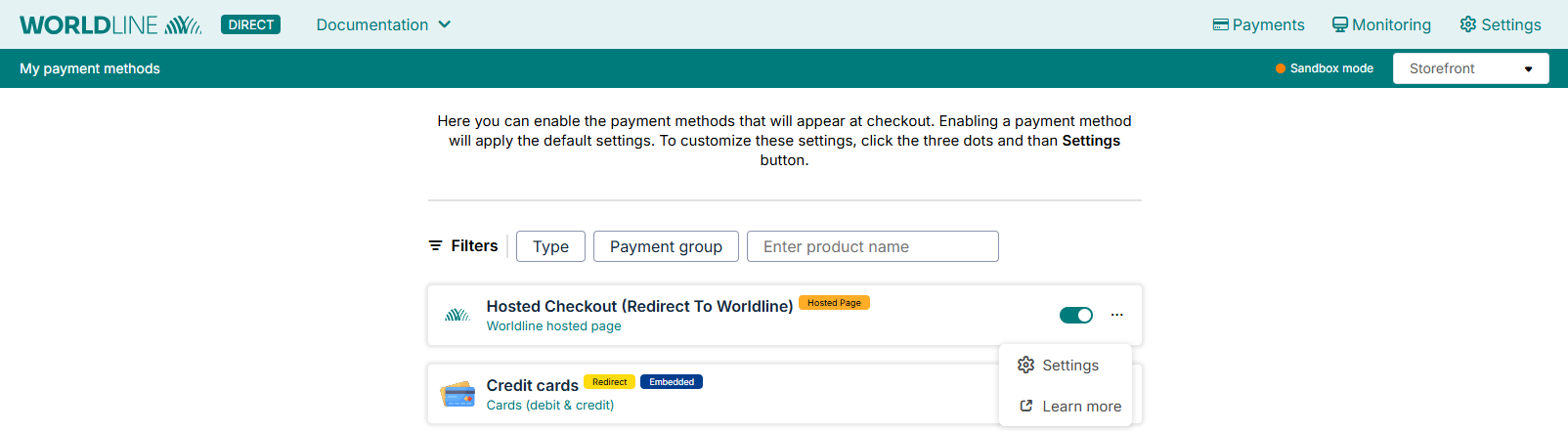
Each checkout option has its own settings. The table below lists only the configurations not described in the "General settings" section.
| Property |
Description/Actions |
|---|---|
| Enable on checkout | Enable or disable the payment method on your checkout page. You can also use the toggle outside of the "Settings" page. |
| Checkout name | Customise the name of the checkout option that will be displayed on your checkout page. |
| Enable group cards | Group all card payment methods under one single button on the payment page. |
| Enable 3-D secure authentication | Modify the setting to disable 3-D Secure for all card transactions. We strongly recommend leaving this setting enabled, as 3-D Secure protocol is mandatory in Europe and disabling it will generate a high rate of declined transactions. |
| Enforce strong customer authentication for every payment | If you have enabled 3-D Secure authentication, you can request every transaction to be strongly authenticated. |
| Enable 3DS exemption | Some markets allow you to potentially exempt your customers from a 3-D Secure check. |
| Exemption type |
When "3DS exemption" configuration is enabled, you can decide which exemption to request.
A customer can receive up to five consecutive exemptions, with a cumulative total of EUR 150. The next transaction that exceeds these criteria will require Strong Customer Authentication (SCA). |
| Exemption limit | Enter the exemption limit in EUR to customise the maximum amount for which an exemption is requested. |
| Vault title | Customise the radio button text in your checkout next to the saved card of your customers. |
| Type (applicable only for Credit cards checkout option) |
Define how cards should be managed on the checkout page. Possible options:
|
| Instant payment only (applicable only for Bank Transfer By Worldline checkout option) | Define whether you wish to only accept instant payments using this payment method. |
| Session Timeout (applicable only for Intersolve checkout option) | Customers attempting to process their payment past this time limit will not be allowed to complete their transaction. Allowed value ranges from 1 minute to 1440 minutes (24 hours). |
| Product ID (applicable only for Intersolve checkout option) | Define the brand of your Intersolve giftcard by providing the exact paymentProductId. For all possible values, see the Intersolve documentation. |
Manage payments
We have designed the plugin to follow-up on your orders automatically and autonomously, freeing you from the administration involved. Learn here how to use our plugin effectively which could help your business to thrive!
Perform maintenance operations
Captures, refunds and cancellations of authorisations are standard processes (maintenance operations) in your everyday business logic. Learn here how to perform these operations directly in the Shopware Back Office:
- Login to the Shopware Back Office. Go to Orders > Overview. Click on the order in the table.
- In the order overview, click the three dots and go to Worldline GoPay details. Depending on the order’s status (column "Payment status" in Orders > Overview), the following buttons are functional:
Worldline / Shopware order status Available buttons statusOutput.statusCode=5 / Authorized - "Capture payment": Capture the authorised amount to receive the funds for the order.
- "Cancel payment": Cancel the authorised amount.
statusOutput.statusCode=9 / Paid - "Refund payment": Reimburse the funds for the order.
Any status "Open in Worldline" will redirect you to our Merchant Portal to check the status of the transaction.
Perform test transactions
Use our platform's test environment to make sure your plugin works as intended. We offer test data sets on our dedicated Test cases page. Target our test environment as described in the "Configure Plugin" section.
Make sure to switch to the LIVE environment as soon as you have finalised your tests.
Debug mode
When you enable debug mode, the app stores additional information about API calls, responses and webhooks. To view it, follow these steps:
- Login to the Shopware Back Office. Go to Extensions > Worldline GoPay > Monitoring.
- You will be presented with two screens:
- Webhooks: Will log all incoming webhooks related to a transaction. The information will be summarised in a grid, but clicking on the three dots will give more information. You can also click the Download button to download the full log file.
- Logs: Will log all API calls and responses performed by the app. The information will be summarised in a grid, but clicking on the three dots will give more information. You can also click the Download button to download the full log file.
Usage of Mealvouchers
Our plugin supports the Mealvouchers payment method. To make it available, you must enable it manually. To do so, simply edit each product individually as follows:
- Go to Catalogues > Products, and click on the three dots next to the product you wish to configure. Then, click on "Edit".
- Click on the three dots, and open Worldline GoPay details.
- Choose between three different values:
Food and Drink
Home and Garden
Gifts and Flowers
Refer to our Mealvouchers documentation to learn more about these product types.
Uninstallation
You can uninstall the app by clicking on the "Uninstall" button. A pop-up window will appear, prompting you to choose whether to permanently remove app data.
Confirming the action will remove all of your shop’s data from the database and unsubscribe from all Worldline and Shopware 6 webhooks.
This feature doesn’t work for 6.5.x versions. The keepUserData field is missing from Shopware’s webhook requests, so the data will not be deleted.